
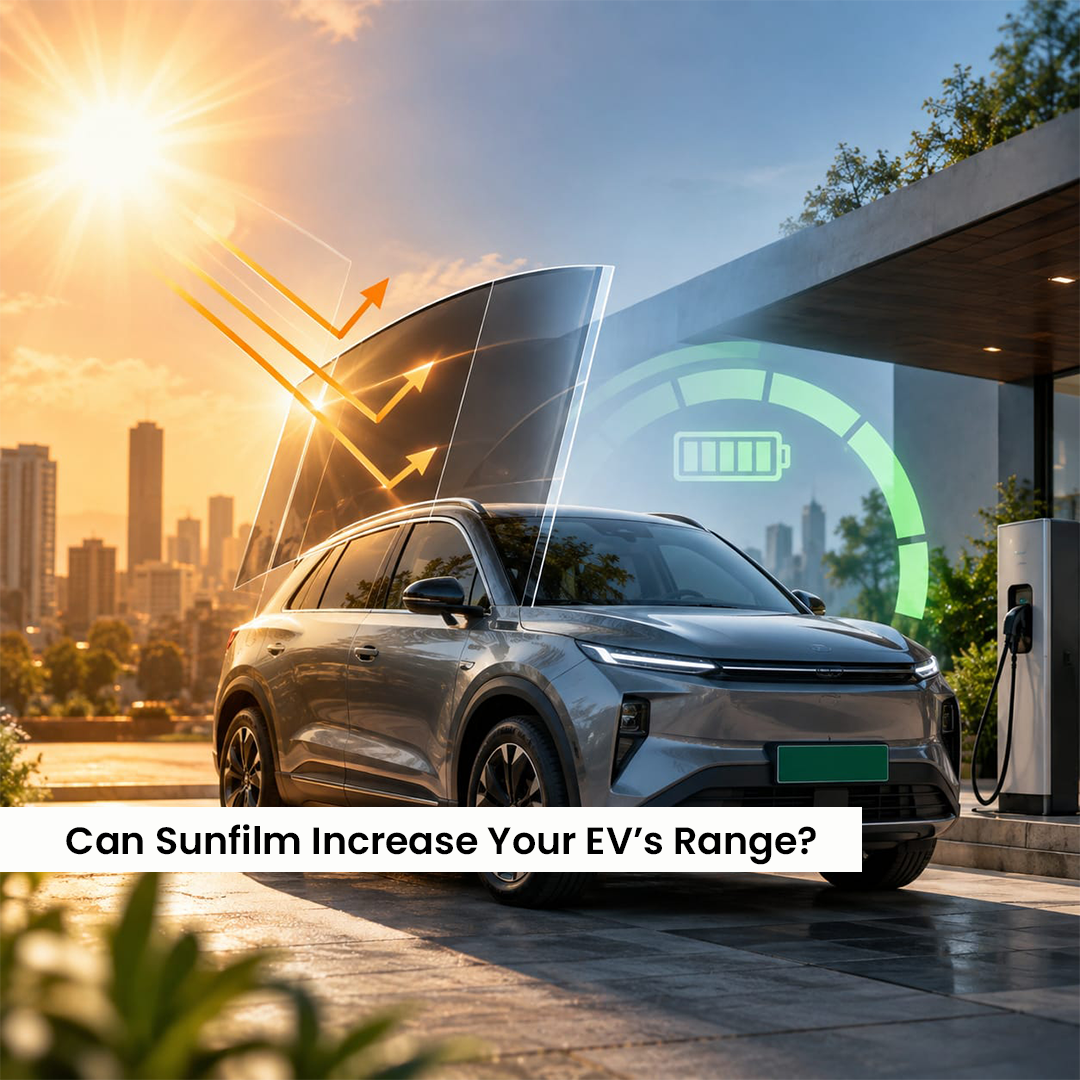
Can Sunfilm Increase Your EV’s Range?
Yes, sunfilm can potentially improve an EV’s real-world efficiency indirectly, but the gain is usually modest. Heat-rejecting window film reduces solar heat entering the cabin, which can reduce the workload on the air-conditioning system. Since an EV powers its AC from the battery, using less energy for cooling can leave more energy available for driving.
How Does Sunfilm Affect EV Range?
An EV parked in Bangalore’s sun can develop a significant cabin heat load. When you start driving, the AC must remove heat from the glass, dashboard, seats and cabin air.
A quality heat-rejecting film can reduce solar heat entering through the windows. That means the cabin may cool faster and require less cooling energy during the journey.
However, sunfilm does not directly improve the battery, motor or drivetrain. Any range improvement comes from reducing the energy used by the AC.
Research into EV cabin thermal management confirms that ambient temperature, solar radiation, humidity, trip length and thermal soak all affect HVAC energy consumption and therefore EV range.
How Much Energy Does an EV’s AC Use?
There is no single number. AC consumption varies with the outside temperature, cabin temperature, vehicle size, insulation, glass area, humidity and how aggressively the system is cooling.
This is why promising a fixed number of extra kilometres from sunfilm would be misleading.
Studies have found that reducing solar heat load can meaningfully reduce cooling demand. One vehicle thermal study reported that a combination of solar-reflective glazing and other heat-reduction measures reduced AC thermal load by more than 30% under its simulated conditions.
How Many Extra Kilometres Can You Expect?
There is no reliable universal figure for extra EV range from sunfilm alone.
For example, if your EV normally uses 15 kWh/100 km, even a small reduction in HVAC consumption could contribute to efficiency. But the actual benefit depends heavily on how hot the cabin becomes, how long you drive and how much of the journey requires active cooling.
Think of sunfilm primarily as a cabin heat-management upgrade, with possible range benefits as a secondary effect.
Dark Tint vs Clear or Ceramic Film
Darkness and heat rejection are not the same thing.
A film can reject infrared and solar energy without being extremely dark. Modern ceramic and advanced solar-control films can provide heat and UV rejection while maintaining relatively high visible light transmission.
For an EV, heat rejection and legal visible light transmission matter more than simply choosing the darkest film.
CarsBuddy offers sun-control film and window tinting in Bangalore, alongside detailing, PPF and other vehicle-protection services.
What About the Windshield and Panoramic Sunroof?
These areas deserve special attention because they can contribute substantially to solar heat gain.
However, Indian regulations are important. Rule 100 of the Central Motor Vehicles Rules specifies minimum visible light transmission requirements, and the Supreme Court has prohibited applying films or other material to vehicle safety glass. The Ministry of Road Transport and Highways has reiterated this position.
Therefore, do not install aftermarket sunfilm on the windshield or other glass without first confirming that the product and installation comply with applicable law.
Pros and Cons
| Benefits | Limitations |
|---|---|
| Reduces solar heat entering the cabin | Range improvement is not guaranteed |
| Can improve cabin comfort | Effect depends on weather and usage |
| May reduce AC workload | Darker film does not automatically mean better heat rejection |
| Can reduce glare and UV exposure | Legal restrictions apply to aftermarket films |
Conclusion
Sunfilm can help an EV use less energy for cabin cooling, which may translate into a small improvement in real-world range. The bigger and more immediate benefit is reduced cabin heat and improved comfort. Choose a quality heat-rejecting film based on performance rather than darkness, and always check Indian regulations before installation.
If you are researching sunfilm in Bangalore, CarsBuddy offers sun-control film alongside detailing, PPF, ceramic coating and windshield protection services.
FAQs
1. Does sunfilm really increase EV range?
It can indirectly help. Heat-rejecting film reduces solar heat entering the cabin, potentially reducing the energy required by the AC. Because an EV’s AC draws electricity from the traction battery, lower cooling demand can leave slightly more energy for propulsion. However, the actual range gain varies considerably and should not be treated as a guaranteed number.
2. Do I need dark tint for better heat rejection?
No. Darkness is mainly related to visible light transmission. Advanced ceramic and solar-control films can reject substantial heat without appearing extremely dark. For an EV, choose a film based on its documented solar-energy rejection, infrared performance, optical clarity and legal compliance rather than choosing the darkest available option.
3. Should I install sunfilm on the front windshield?
Be careful. Indian law restricts aftermarket films and other material applied to vehicle safety glass. The Supreme Court has prohibited such applications, while CMVR Rule 100 specifies VLT requirements for vehicle glass. Check the current legal position and have the installer verify compliance before considering any windshield application.
4. Can sunfilm make a noticeable difference in Bangalore?
It can make the cabin more comfortable, particularly when the vehicle is parked outdoors in strong sunlight. The potential efficiency benefit is greatest when solar heat is a significant part of the cooling load. CarsBuddy specifically offers sun-control film in Bangalore, along with other detailing and protection services.
5. Should I install sunfilm on the front windshield and panoramic sunroof?
Yes. A high-transmittance ceramic sunfilm blocks significant solar heat and UV rays without sacrificing nighttime visibility or requiring you to keep your sunroof shade closed.